

Greengauge’s key takeaways from the UK Passivhaus Conference 2026
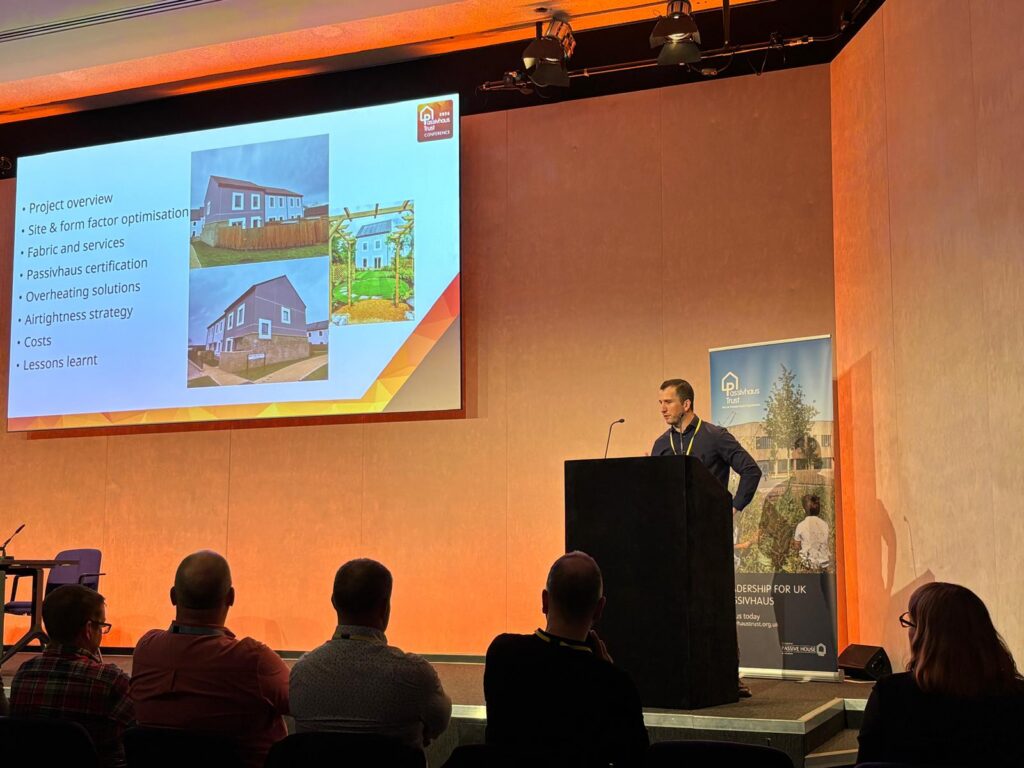
Greengauge Building Physicist Mitch Finn and Director & Passivhaus Certifier Paul Smith both attended the UK Passivhaus Conference 2026, with Mitch presenting a talk on the Elm Grove Passivhaus social housing scheme.
The conference offered stimulating learning and inspiration, as well as a chance to meet up with others in the Passivhaus community. Here are their key takeaways
Paul’s key takeaways
The Embassy
There was a great session at the Irish embassy earlier that week, organised jointly by the Passivhaus Trust and the Passive House Association of Ireland. Close neighbours. It makes sense to share ideas and approaches. There is a lot of positive Passivhaus activity over in Ireland and the message was overwhelmingly upbeat. Peabody, GRAHAM and KORE all made powerful contributions to the discussion. Passivhaus could be an unstoppable force if the Guinness and conversation are anything to go by. Always a treat.
On the road
London. Again. I kind of understand why, and the size of the venue no doubt brought the “wow” factor for a number of people. But good to see next year is Swansea. I may have an opposing view, being a Northerner and all, but spreading these events to places where Passivhaus activity and awareness can grow provides a conduit for positivity. The intrigue, passion and purpose that come with them should only help. Raise the awareness, invigorate and educate, and each location is primed to carry the momentum and drive implementation. Then on to the next. And the next.
Aim high. Hold on.
Professor Diana Ürge-Vorsatz set out what everyone in the Passivhaus community should be striving for: as close to 100% as possible. We wholeheartedly concur. Aim for 100% and we might hit 80%, or 50%. It is easy to lead with Passivhaus and then let it slip when the conversations get tough and the inevitable pushback comes. That is exactly the point to hold on. When things get difficult, dig deep and don’t let the standard drop. We need to keep our ambitions high enough for the scale of the
problems we face.
Basics first
There is always a temptation to layer further complexity onto the standard. A standard that is still only at around 1% of new homes on the Passivhaus Trust’s own estimate, a drop in the proverbial rising ocean. We could do with getting buy-in to the basics first. It is hard to progress a standard that lacks adoption in the first place. Especially one that many still assume is too hard to attain. Let’s not forget that the Passivhaus Standard as it stands is far more effective at delivering on its promises than standard new build, and we shouldn’t lose sight of that.
Complexities are worth discussing. But for now they should probably come through guidance and position papers, shaped by the certifiers, designers and trades delivering the buildings. Nobody should be put off, or handed more excuses through overreach baked into the criteria, before they’ve even started.
They said it couldn’t be done
Great to see Jamie Gregory of AHR talk through the steel frame projects they have delivered for Fife Council.
One of the first Passivhaus projects I was involved in was Denby Dale. At that time it was said that Passivhaus couldn’t be achieved in brick and block cavity wall. The same is being said of steel. And whether we like it or not, steel is a pragmatic choice for many teams. They have made it work, and the methodology has evolved with each project. So hats off to AHR and the wider team for developing projects that continue to widen uptake by using methods of construction familiar to the majority.
I’m proud to have contributed as Passivhaus Certifier on two of them, Templehall Community Hub and Caledonia High School. And to top it off, celebrating the recent certification of Caledonia High School with a pint, and passing on the certificate and plaque in person, was a nice end to the events.
Mitch’s key takeaways
The urgent need to reduce energy demand
The keynote speech from Professor Diana Ürge-Vorsatz outlined the crucial importance of energy demand reduction. The predicted increase in expected renewable generation over the next 5 years is expected to be used up by predicted increase in energy demand, so although renewable electricity generation is increasing, we still need to reduce energy demand. Interestingly, within this increase data centre energy (which tends to get a lot of attention, particularly with regards to AI) was less than industry, electric transport, appliances and space cooling.
Overheating
Minimising overheating was a key theme of the conference. An alarming fact shared by Joel Callow from Beyond Carbon was that the CIBSE weather files that most matched the UK’s 2026 behaviour was in fact those for 2080 (in terms of peak temperatures at least). Current Building Regs use 2020 climate files, so we are clearly very badly out of sync. Rising temperatures will have a knock-on effect on optimal g-values, with the suggestion that these should be reduced from 0.5 to 0.35. A g value of 0.5 currently offers good solar gain contributing towards space heating but also limiting summer solar gain. But now it is being suggested that now the optimal is more like 0.35, because overheating is becoming much more significant. Ceiling fans were also flagged as a strategy due to their cooling effect (improving evaporation from skin rather than affecting air temperature) which can lower perceived temperature by around 3°C (though this isn’t factored into Part O modelling).
Space heating demand or Heat load?
A good case was made for meeting Passivhaus criteria through heating load rather than heating demand as it doesn’t rely significantly on solar gain to meet the target.
With the space heating demand method, you can significantly reduce the figure by introducing solar gain through excess glazing. By contrast, the heating load metric is based on a winter day without much solar gain and so it tends to rely more on fabric. So, the suggestion was that using the heat load method is a more robust longer-term approach.
Reducing peak electrical demand
I also attended a talk showing how Passivhaus reduces peak electrical demand which offers developers and the national grid benefits. Building to the Passivhaus standard could reduce any requirements you have for electrical infrastructure, but also, it’s a benefit to the UK energy mix because it’s difficult dealing with lots of peaks in energy demand for grid capacity.
Air-testing skyscrapers
Lastly, I enjoyed listening to the talk by Warren Stanley of Henriksen Studio of the air testing of the three towers that comprise the Urbanest Canary Wharf project. What was amazing was that they managed to do a massive single air test on the project, which is now the tallest Passivhaus single air tightness test in the world! It required over 2400 door wedges to keep internal doors open during the test.
Paul Smith is a Passivhaus Certifier and Director at Greengauge.
Mitch Finn is a Building Physicist at Greengauge


